

My ICU Reading List
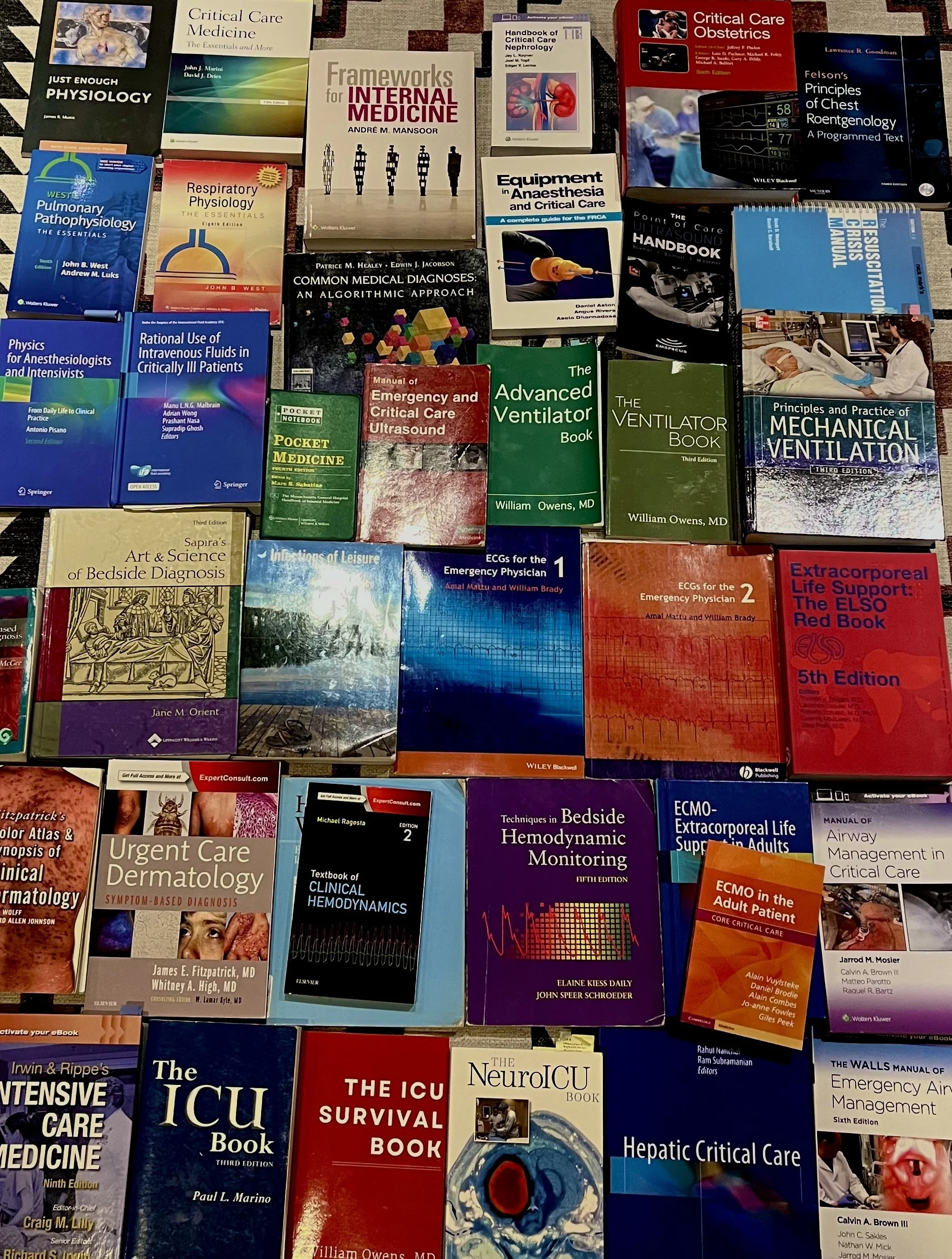
People often ask me what my favorite books are for learning critical care, so I decided to put together a list of my favorites.
In 2025, medical books may seem passé. Books are expensive to buy, bulky to store and transport, hard to search, and many alternatives are now available (podcasts, youTube, infographics, etc). Even as someone who's obviously a big believer in alternative forms of education, I still think there is a role for books in medical education.
Part of the allure of watching or listening is that it's passive, whereas reading forces you to be more focused and attentive. Reading - and taking notes - allows you to retain more. If you are trying to learn a subject durably (e.g., not for an exam or for rounds) this is important.
Recent articles will always be more up to date than a text; the typical book is 3-5 years behind when it's printed and it doesn't get more accurate sitting on a shelf. But some topics (e.g. physiology) change relatively slowly. Articles - even good reviews - rarely match the breadth and scope of a text. If you desire comprehensive knowledge, a medical book can still be a great teacher.
For learners new to the ICU, hopefully this list can inspire you to pick up a book. For more experienced ICU providers - including those with CME funds to spend - this list may help you find some new texts. I want to be clear that this isn't a "annual reading list" - It took me 20 years to collect this "library" and I haven't read it all cover to cover (far from it!)
This list is long. For convenience I've broken this list into sections. I've rated each book based on who it's best using a repurposed ski-trail difficulty scale (🟢 = good for beginner, 🟦 = intermediate, ◆ = expert). As with ski slopes, just because a book is “safe” for beginners doesn't mean an "expert" won't enjoy it.
Physiology
Physiology is foundational in critical care. Much of what we do comes down to understanding and adjusting our patients physiology. These texts will help you understand physiology so you can apply it in your ICU.
Just Enough Physiology (Munis)
Rating: 🟢
This is a gem; a great introduction (or reintroduction) to physiology for anyone working in the ICU. It manages to be comprehensive without being a massive tome. It’s also a quiz so it forces you to be an active learner.
Oxygen: Reacting a New Paradigm (Marino)
Rating: 🟦
Written by the guy who literally wrote the book on the ICU, well the ICU book (see below), this recently published book is a fantastic read for anyone interested in the physiology of respiration, oxygen transport, delivery, and utilization. I have spent many years reading about this and still learned a lot.
West’s Pulmonary Physiology & West’s Pulmonary Pathophysiology (West & Luks)
Rating: 🟢
I was trained by Andy Luks, who is the undisputed master of applying pulmonary physiology, and this is his knowledge distilled down into two concise volumes. IMO, these two books are essential reading for understanding pulmonary physiology and pathophysiology. (aka PCCM fellows!) For those interesting in going deeper (aka people teaching PCCM fellows) you can pickup the longer version of pulmonary pathophysiology (not “the essentials”).
Physics for Anesthesiologists and Intensivists (Pisano)
Rating: 🟦
I really wanted to write a book just like this, until I found this masterpiece. Now I don't have to! This book explains the underlying physical principles behind many of the therapies and devices we use every day.
I highly recommend this for people like me who want to understand the why behind the what in the ICU!
Equipment in Anesthesia and Critical Care
Rating: 🟦
Another must have for understanding how our equipment works and the principles that underlie it. Very bite sized and graphic heavy reading. If you like ICU OnePager you'll love this.
Critical Care
There are several great critical care texts, that have taught me a lot. These suffer from the problem that they may be out of date by the time they are printed, but its better to learn a framework and iteratively add recent trials to it.
The ICU Survival Book (Owens)
Rating: 🟢
I was a big fan of Owens’ ventilator books for years, but I only recently discovered this book and I think its really fantastic. Great for medical students, interns, and other people who are new to the ICU. He does a good job providing a nice concise summary of many topics.
The ICU Book (Marino)
Rating: 🟦
This classic by Critical Care GOAT Paul Marino provides an excellent overview of why we do the things we do in the ICU. Be sure to get the latest edition (5th edition published 2024) as the earlier editions are a bit out of date.
The Washington Manual of Critical Care
Rating: 🟦
A nice comprehensive summary of critical care medicine. At 700 pages it's not quite as intimidating as Irwin & Rip.
Irwin & Rippe’s Intensive Care Medicine
Rating: 🟦 - ◆
the OG Critical Care textbook; the Harrison’s of the ICU. Massive but I still get this out to read about new subjects, especially for topics I don't see everyday (esp. for the podcast).
Principles and Practice of intensive care monitoring (Tobin)
Rating: ◆
Mark Twain defined a classic as "a book which people praise and don't read". Unfortunately Tobin's ICU monitoring is a classic in this sense because few read it. (Unfortunately it's out of print)
This book really explains how and why we measure things in the ICU. If you can track it down, it's a great use of CME funds that will enrich your know
Internal Medicine
Whether you are IM trained or not, internal medicine is a core competency in the ICU. These are some great books to learn and for reference.
Pocket Medicine (Sabatine)
Rating: 🟢 - ◆
Don’t let its small size fool you. This little book is an ultra-concise "bible" for internal medicine knowledge. It really does have a ton of knowledge, including crucial studies. Beginners and experts alike can learn from this, or use it as a reference.
Though I haven't worn a white coat in a decade, but when I did this book was always in the pocket! I learned so much by reviewing this book over the years. I highly recommend it.
Frameworks for Internal Medicine (Mansoor)
Rating: 🟦
This is one of my favorite books for reviewing IM topics. It's concise with great graphical schema for approaching different diseases. Good for learning or reviewing medicine.
Common Medical Diagnoses: An Algorithmic Approach
Rating: 🟢 - 🟦
Harrison's is the classic text, but when I read it I remember thinking "you have to know the diagnosis to look it up". This book flips the paradigm, starting with a problem and guides you through the workup. Wonderful flowcharts and full of crucial little details. I love this book.
Ventilators
The Ventilator Book and The Advanced Ventilator Book (Owens)
Rating: 🟢 - 🟦
IMO these two books are mandatory for anyone who manages ventilators. Very accessible yet thorough. Short enough that you can easily sit down and read them, but with enough details that you’ll probably read them again.
Tobin's Principles And Practice of Mechanical Ventilation (Tobin)
Rating: ◆
THE definitive guide to mechanical ventilation. Detailed explanations of everything related to ventilation and ventilators. Combines a detailed history with mechanistic nuance.
Airway
Managing airways is one of the riskiest and most skill dependent aspects of critical care. Mastering the art, science, and skill of intubation requires more than hands on experience. You need to think about and prepare for contingencies in advance. I highly recommend these books.
Airway Cam Guide to Intubation and Practical Emergency Airway Management (Rich Levitan)
Rating: 🟦 - ◆
A must read for anyone who intubates. Great illustrations, step by step, comprehensive guide.
Manual of Airway Management in Critical Care (Mosier)
Rating: 🟦 - ◆
This book isn't afraid to take positions and is full of great tidbits. I also really like the summary at the end of each chapter. Be sure to listen to the podcast episode I did about Airway Controversies with the author (Jarrod Mosier).
CV
Hemodynamics gives us the clues we need to understand cardiac physiology. Learning to recognize subtle patterns in EKGs and waveforms is essential. I highly recommend these books:
Textbook of Clinical Hemodynamics (Ragosta)
Hemodynamic Waveforms (Daily)
Techniques in Bedside Hemodynamic Monitoring (Daily)
Rating: 🟦 - ◆
Understanding the nuances of hemodynamics waveforms is a key skill in the cardiac ICU (and on boards). This trifecta is a great cased based way to learn (if you can find them in print). Pick them up used if you can for a great deal.
ECGs for the emergency physician 1 & 2 (Mattu & Brady)
Rating: 🟢 - 🟦
I have fond memories of reading this book in the fire station where I worked as a EMT-cardiac. (a few years ago...) I learned a lot then, and I still learn a lot when I pick these books up. There is no better way to learn and master EKG interpretation than to read these books by master clinicians. My only criticism: this series deserves to be a trilogy!
Recommendation: make a photocopy and write out your interpretation as you go, just like you were really interpreting the EKG. This forces you to commit to your answer & you'll learn more when you get it wrong
The ELSO Red Book
Rating: 🟢 - ◆
A must read for anyone who cares for patients on ECMO. Good reference if you are caring for your first or your hundreth ECMO patient.
GI
Hepatic Critical Care
Rating: 🟦 - ◆
If you, like me, work at a center that does a lot of liver transplants I recommend this book. Not too long, but quite detailed.
ID
Infections of Leisure (Schlossberg)
Rating: 🟢 - 🟦
I LOVE this book. There's something magical about chapters like "With Man's Best Friend"(infections from dogs), "The Camper's Uninvited Guests" or "Perils of the Petting Zoo." For the non-ID doc this is a great summary of exposures to infections, with just enough information about each.
A great reminder of all the fascinating - and terrifying - bugs around us. Wash your hands after reading!
Nephrology
Handbook of Critical Care Nephrology (Koyner, Topf, Lerma)
Rating: 🟦 - ◆
If you care for people with kidneys - working or otherwise - I highly recommend reading this fantastic overview of nephrology in people with critically illness. As a bonus, be sure to listen to the podcast episode I did with one of the authors (Joel Topf) about hyponatremia.
Rational Use of Intravenous Fluids in Critically Ill Patients
Rating: ◆
This is, IMO, the definitive book about IV fluids in the ICU. Detailed. A great source for the "why behind the what" for an intervention we use on every patient every day.
Neurocritical Care
The NeuroICU Book (Lee)
Rating: 🟦 - ◆
The single best book to prepare for working in the NeuroICU IMO, this book has it all: stroke, seizure, tumors, trauma, infection, and more. Helpful to understand the neurologist and neurosurgeons perspective too.
Surgery & OB
Critical Care Obstetrics
Rating: 🟦 - ◆
The saying goes: "You fear the most what you know the least.” Coming out of fellowship, I I didn’t know nearly enough about OB emergencies and it was a source of great anxiety.
Working at one of the busiest OB hospitals in the US I needed to get past that and this book has been a great help.
Current Therapy of Trauma and Surgical Critical Care (Trunkey)
Rating: 🟦 - ◆
As an non-surgeon the OR is sometimes shrouded in mystery. This book has helped demystify the care of the surgical critical care patient somewhat. Great to pickup when you encounter a new type of surgery or unexpected complication.
Radiology
Felson's Principles of Chest Roentgenology
Rating: 🟢
A nice interactive, visual summary of how to read a chest radiograph. Good to work your way through step by step.
Pharmacology and Toxicology
Goldfrank's toxicologic emergencies
Rating: 🟢 - ◆
THE book on toxicology. If you love biochemistry and rare diseases this book is for the you. There are some chapters every intensivist should read (sympathomimetics, opioids, anticholinergics, etc) and others you should read when you see interesting stuff.
Code Blue Pharmacology
Rating: 🟢 - 🟦
Great highly detailed overview of the medications used in cardiac arrest and the studies behind them.
The Vasopressors and Inotrope Handbook
Rating: 🟢 - 🟦
Great introduction to the theory and studies behind medications we use every day. You can find all of this content in other critical care texts, but its nice to have it all in one place.
Physical Exam & POCUS
I’ve been holding out on you and saving some of my favorites for last.
They say that physical diagnosis is a dying art, and they've been saying this for centuries. After Laneac invented the stethoscope, experienced doctors lamented that trainees were no longer as good at percussion. One doctor quipped that the prior generation of physicians was so good they could tell who was in the house by knocking on the door. The reality is that the physical exam isn't dying it is - and always has been - changing, incorporating new skills and discarding antiquated ones.
Obviously the physical exam is learned at the bedside, but books are essential to prepare you and to help you master it. Here are a few of my favorites:
Sapira's Art & Science Of Bedside Diagnosis
Rating: 🟢 - ◆
I had a mentor in medical school who introduced me to this book, and it really changed my perspective. Physical diagnosis includes a lot of old useless skills (percussion) in the age of ultrasound, but there are ton of important physiological clues too. This book is a wonderful synergy of history, physiology, and the art of physical diagnosis. It helps you understand the difference between esoteric details and crucial clues. Recommended for all.
Evidence based physical diagnosis (McGee)
Rating: 🟦 - ◆
I trained with Steve McGee, who is absolutely brilliant. This book is his magnus opus. It helps differentiate the physical exam maneuvers that work (e.g. sonographic murphy's sign) from the ones that don't. If you like EBM and physical diagnosis, this book is a must read.
Urgent Care Dermatology
Rating: 🟢 - ◆
The key to any good dermatology book: lots of pictures. This is a great symptom based approach to dermatology.
Fitzpatrick's Color Atlas and Synopsis of Clinical Dermatology
Rating: 🟢 - 🟦
This is the smaller companion to the gold standard derm textbook. Great both as a reference and for learning about dermatology more comprehensively.
Manual of Emergency and Critical Care Ultrasound (Noble)
Rating: 🟢
This book was a game changer for me in residency. There are many great ultrasound websites, podcasts, youtube channels, etc but this book is worth owning IMO.
Recommendation: also buy yourself a USB drive so you can begin saving POCUS images/videos.
The Point of Care Ultrasound Handbook
Rating: 🟢
A nice, very concise and very graphical summary of point of care ultrasound
POCUS Manifesto (Istrail)
Rating: 🟦
I really like how this book merges POCUS with EBM - kinda like what Steve McGee’s book does with physical diagnosis.
I hope these books are as helpful to you as they were - and are - to me. Please leave me comments with your favorites and feedback.